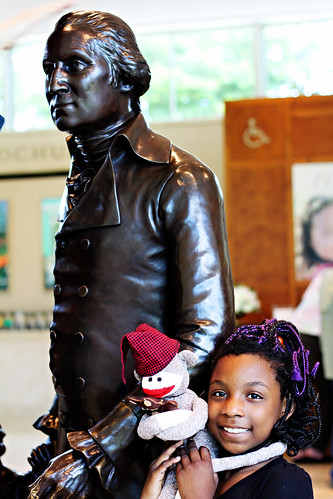
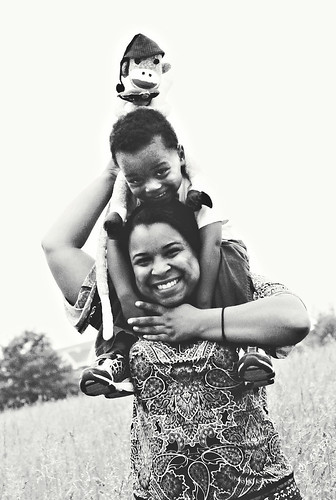
We're okay. That's what is most important right now. When the earthquake hit Mineral, Virginia, we were some 130 miles north in D.C. visiting the newly unveiled Dr. Martin Luther King Jr. Memorial. As we walked across the bridge away from the Washington Monument toward the Mountain of Despair, the ground began to quiver. The movement was slight, but the lamp posts shook ferociously from side to side.
We're okay.
The significance of the day's events is so heavy that my mind is still racing to grasp the experiences into a logical package.
It began with a play date - - a simple trip into the city to see the new monument.

I suppose, when you consider the monument we were going to see, that it was more than that from the start. Nickea, with her fair skin and bright hair, and I with my dark complexion and ebony hair strolled along with our children to see a memorial to a man whose dream it was to see prejudice eradicated and justice abundantly served - - the power of our contrasting appearances is not lost on me.

Let us all hope that the dark clouds of racial prejudice will soon pass away, and that in some not too distant tomorrow the radiant stars of love and brotherhood will shine over our great nation with all their scintillating beauty.
Martin Luther King, Jr., Letter from Birmingham Jail

Kea teared up as we passed through the "Mountain of Despair" and saw the magnitude of the memorial site. I saw her glazed eyes and I chuckled. I don't know why. I asked, "
Are you crying?" as though her raw emotions were somehow unexpected. I hugged my friend then, stroked her back as she wiped her tears and regained composure. And as she slide on her dark sunglasses to mask her weeping eyes, I realized (far slower than I care to admit) the significance of being in this place with her.

Our friendship - our ability to share our pregnancies, to experience our sons' milestones and life passages, to even sit down to dinner together and banter about nonsense - is something that would have been scrutinized, despised, and destroyed in the racially charged present of the 60s and 70s. And yet, our relationship is natural and it is cherished today. We teach at an ethnically diverse school. We live in an area where kids of every background frequent the playgrounds. We are living out
the dream.

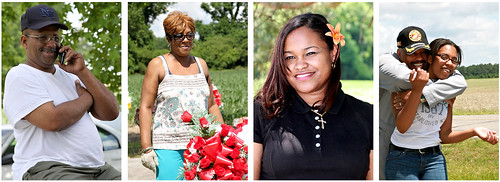
While we stood reading the quotes selected for the walls around the King sculpture, we overheard Marie Davenport. "I was here with him at the March," she said. "I was here." Her companion, a jovial looking man, smiled broadly as he composed a picture of her standing next to one of the quotes. After he snapped his shot of Marie (whose infectious smile radiates on her face), the two wandered away from us to admire the stoically-carved likeness of Dr. King.
Kea saw the couple outside the memorial later and we struck up a conversation. Her husband, Rudi, native of Frankfurt Germany, stood off to her side while she recollected her work teaching for the Department of Defense schools. Marie, now 74-years-old, chatted with us for some time. She gave Chi her first person accounts of the Civil Rights Movement she was immersed in, and like any good teacher, tried to offer a context for my 8-year-old who's not yet felt the sting of boundaries set before her due to her color. "I was here when he said 'I have a dream," she said. "I was a young woman then. And here today, I was standing there looking up at King and then
I saw the earth move."
Indeed, the earthquake came at a moment when hundreds of people were paying homage to a man whose personal convictions helped shape history and rocked - cracked, even - the foundation of inequality and injustice that the country was content to foster.

Our trip back from the city was harried. Fearing the Metro would shut down because of additional tremors (or full blown after shocks), we cut our trip short and sought the train station. Buildings along the Mall had been evacuated, leaving the many employees to loiter outside. Many Federal offices closed early as precaution, the workers leaving in droves. Access to the Washington Monument was halted, as Special Police lined the streets and redirected pedestrians to other walkways and spaces. It was controlled chaos.
The trains on Metro were confined to one track and travel speeds were reduced to 15 MPH. The subsequent wait for trains was endless. We were pushed into the opened doors of one train car amongst a frightening mass of would-be passengers. The woman announcer chanting "Please stand back, doors closing," droned on and on as people pushed and shoved and fussed. I fought to keep briefcases and legs away from my son sleeping in his stroller, while I was mashed uncomfortably into the wall separating the train's doorway and the handicap seating. Each stop brought more passengers, but there were few who disembarked to allow for the extra people. And the train moved slowly along the tracks while people bickered and whined about being touched, pushed, and squeezed.
When our stop finally arrived, we were pushed so ferociously out of the confinement of the train that I felt as though I had experienced some sort of rebirth into freedom.
Back home, I braced myself as I walked through the house assessing the damages. Pictures lay on the floor, their empty hooks mocking me from the wall. Several trinkets, framed photos, and other tchotchkes were strewn about. Papers, magazines and books were no longer neatly filed on their shelves. But, all in all, it was minor clean up. Except in Chi's room. There, the newly placed shelves had pulled from the wall leaving gaping holes. Her television bore a hole and the picture on the flat screen is shattered like glass on one side. But what is devastating about the damaged items is the loss of the amazing painted figures Chi had done when she was 3-5 years old. She wept as she picked up the broken pieces of her art. I can't replace them, but we will create something new from their remains.
And now, as both kids sleep off the exhaustion of their day, I sit here thinking. Today was historical. Today was something powerful. Today will shape our tomorrow.


 Ok, did anyone happen to notice that I said I was driving a VAN? Yes, to fit my family of six (plus Oma), we had to get a bigger vehicle. Poor Celi sat at home and I missed my sleek, speedy sports car terribly as I whipped through traffic in the Chrysler Town & Country beast. I suppose this is one of those turning points in parenthood - when the car of choice is no longer functional for transporting the growing family.
 So the "honey" in this vaykay is the sweet that comes from realizing that this man of mine gives my heart flutters whenever he says "I love you." It's his insistence that the pudgy girl I've always been known as is beautiful in his sight no matter what the mirror reports. It's those times when we say the same thing at the same time without intention. It's the hugs, hand holding, and kisses of someone who adores me (and it's reciprocated).


 It was raining last weekend when I took the kids into the city. The plan was to go to the American Indian Museum, but apparently, if you don't take the L'Enfant Plaza stop on Metro, it's not nearby (read: I couldn't find it despite the straight line of Smithsonian museums). We ended up climbing the 100 or so stairs to the National Art Gallery (the accessible entrance is all the way around the building, not on the Mall side). Chi decided the museum was inappropriately naked, so we left after seeing only one floor.


 I did it. I DID IT!